

Managing field sales, direct store delivery (DSD), and order management can be surprisingly messy. Many teams still rely on several disconnected systems — one app for shelf audits, another for taking orders, a spreadsheet for routes, and yet another tool for invoicing.
This scattered approach often causes data entry mistakes, slower reorders, and missed sales from out-of-stocks.
For CPG brands, distributors, and wholesalers, the goal is clear. Give your field team one mobile app that does it all — audits, orders, routes, and accounting sync. The best platforms reduce manual effort, keep inventory more accurate, and help you collect payments faster.
In this article, we look at several platforms that take different approaches. We evaluate them based on real workflow strengths, pricing, and integrations. The following sections will show you what to look for, followed by individual platform reviews and a conclusion to help you find the best fit.
What to Look for in These Platforms
When evaluating platforms for field sales, DSD, and order management, focus on these key areas:
Field Mobility & Offline Functionality
Your team needs to work reliably even without the internet. Look for strong offline support for order capture, audits, and proof of delivery, with automatic sync when online.
Workflow Coverage
Choose a platform that matches your real needs — whether that’s full retail execution with audits and photos, or just basic order taking and customer portals.
Integration with Accounting & ERP
Orders and invoices should sync directly into QuickBooks, Shopify, NetSuite, or your main system without manual work.
Pricing Model & Contract Flexibility
Prefer simple monthly per-rep billing with no annual contracts, no user minimums, and no setup fees. A good free trial with training is also important.
Geographic & Language Support
US/Canada-focused teams have more options, while multi-region businesses should ensure multi-currency and multi-language features are included.
Support Responsiveness
Read recent user feedback on G2 or Capterra. Quick support response times can make a big difference for distributed field teams.
Overview of the Platforms
The first platform reviewed is designed for CPG brands and distributors that need more than just order taking. It combines retail execution—shelf audits, planogram compliance, photo reporting, and in-store demos—with field sales, DSD route planning, van sales, and invoicing in a single mobile app.
Unlike audit-only tools or basic order capture apps, this solution closes the gap between what happens on the shelf and what gets ordered and delivered.
SimplyDepo
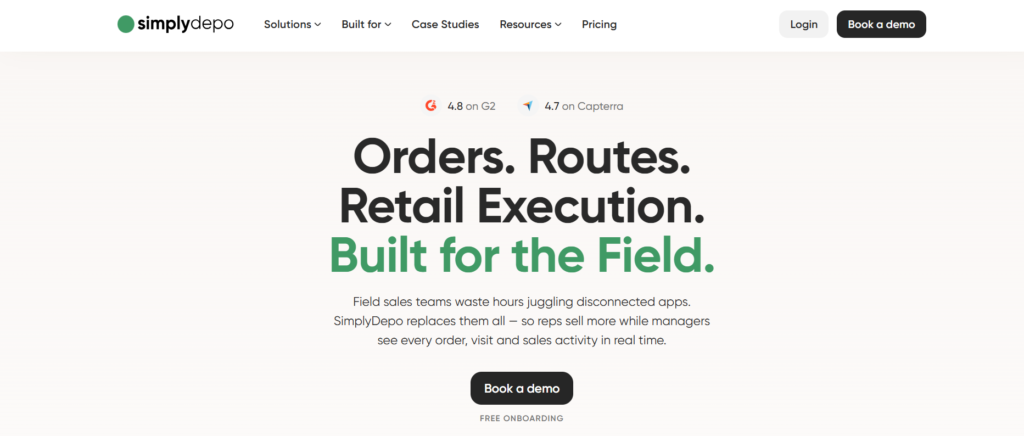
SimplyDepo helps CPG brands and distributors manage their field sales and direct store delivery (DSD) in one easy-to-use mobile platform.
Rather than using separate tools for audits, orders, and reporting, it brings everything together: shelf audits, planogram compliance, photo reports, in-store demos, route planning, van sales, and invoicing. It also syncs natively with both QuickBooks and Shopify, which cuts out a lot of manual data entry.
The platform is a good fit for teams of 1 to 100 people — reps, merchandisers, and route drivers — working across the US and Canada. Because it works fully offline, your team can keep going even in areas with poor signal. Data syncs automatically as soon as they’re back online.
You can plan routes, handle van inventory, and record proof of delivery right from the app.
Pricing starts at $89 per rep per month. There are no annual contracts, no minimums, and no setup fees. Plus, you get a 30-day free trial with free team training included.
Pros
- One unified system for field sales, DSD, and orders – eliminates manual handoffs.
- Allows reps to verify planograms and place orders during the same store visit.
- Fast setup with clear pricing and no surprise fees.
- Fully offline-capable, ideal for rural or low-connectivity areas.
- Direct QuickBooks and Shopify integrations without any middleware.
Cons
- Only available for the US and Canada.
- Not the best fit for audit-only teams.
- Built for field activity, so it offers limited value for eCommerce or remote sales teams.
Who Should Still Choose SimplyDepo
SimplyDepo works really well for SMB and mid-market CPG brands and distributors in the US and Canada that still rely heavily on in-store visits.
If your team needs to handle shelf audits, capture orders, and manage deliveries all in one place, this platform makes things much easier. Many companies today are juggling separate audit apps, order apps, and spreadsheets. SimplyDepo lets them replace all of that with a single mobile workflow.
It’s especially useful for teams that want a practical solution without paying enterprise-level prices or going through long, complicated implementations.
Zoey
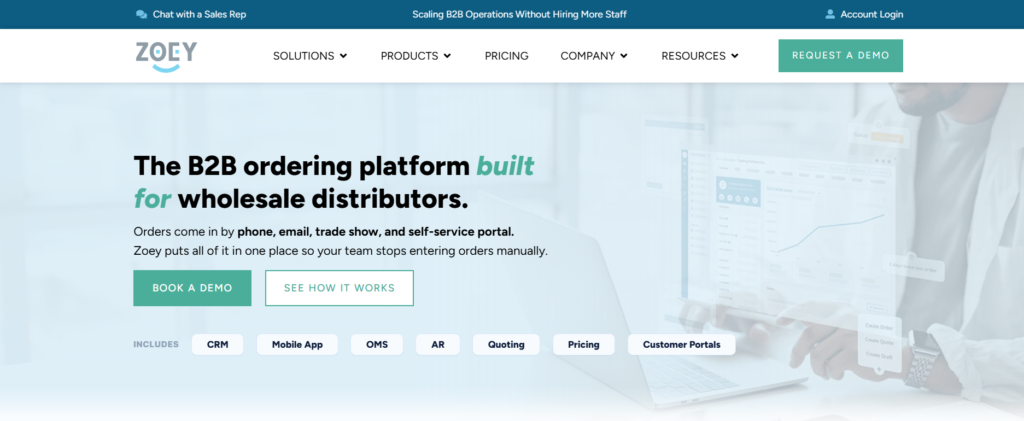
Zoey helps wholesale distributors, manufacturers, and B2B brands manage orders more efficiently. It centralizes intake from sales reps, customer portals, phone calls, and email all in one platform.
Customers can handle most things themselves through an intuitive self-service portal — checking prices, reordering, and placing orders independently. Sales teams get mobile and desktop tools to build quotes, log orders, and manage accounts on the go.
It combines CRM, order management, invoicing, and receivables automation into a single flow. Expect features like quick quote-to-order conversion, split shipments, and automated billing that reduce manual work. Plus, it integrates well with NetSuite, QuickBooks, and ShipStation.
Simply put, Zoey focuses on making B2B sales and back-office processes smoother. It’s not designed for retail tasks like merchandising or route management.
Pros
- B2B ordering portal with built-in CRM and AR automation.
- Customer self-service portals with custom pricing and quoting.
- Native integrations with NetSuite, QuickBooks, and ShipStation.
- Quote-to-order conversion and split shipment capabilities.
Cons
- Slow support and delayed response times (Capterra reviews).
- Limited third-party integrations (Capterra reviews).
- May not fully meet the needs of larger businesses (Capterra reviews).
Who Should Still Choose Zoey
Zoey is a good choice for wholesale businesses that want to centralize order intake and enable customer self-service. Companies that rely on B2B eCommerce portals, quoting, invoicing, and account management will benefit from its functionality.
It is particularly useful for teams that want to reduce manual order entry and improve back-office efficiency without focusing on field execution.
B2B Wave
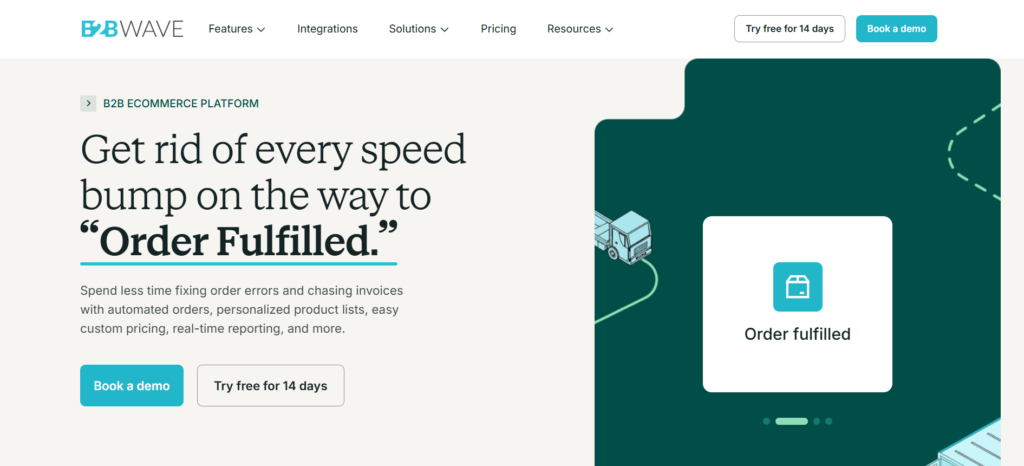
B2B Wave helps wholesale distributors, manufacturers, and suppliers manage their online ordering in one clean system. It’s built around a branded customer portal where buyers can browse products, see personalized prices, and place orders themselves.
You get all the usual essentials — product catalogs, inventory tracking, order history, and custom pricing for different customers. The reporting features give you a good overview of sales, customer behavior, and stock levels. Setting up discounts, pricing rules, and payment methods is straightforward, too.
It integrates well with popular tools like QuickBooks, Xero, Stripe, and ShipStation, so your data doesn’t get scattered across different systems.
B2B Wave focuses on self-service eCommerce. It’s not designed for field sales teams, shelf audits, or DSD workflows. If your business runs mostly on online ordering, it’s a solid fit. If you need strong mobile field execution, you might need something else.
Pros
- Easy-to-use B2B eCommerce platform.
- Strong for branded storefronts, custom pricing, and order management.
- Wholesale customer portals with self-service ordering.
- Integrates with QuickBooks, Xero, Stripe, and ShipStation.
Cons
- Limited advanced analytics and reporting (G2 reviews).
- Integration limitations and manual data handling (G2 reviews).
- Performance issues with large catalogs or high usage (G2 reviews).
Who Should Still Choose B2B Wave
B2B Wave is best suited for small to mid-sized wholesalers that want a simple and accessible B2B eCommerce solution. Businesses that prioritize online ordering, custom pricing, and customer portals will find it effective.
It is a good option for companies that operate primarily through digital channels and do not require field sales, retail audits, or DSD workflows.
Conclusion
The right platform depends on your team’s workflow.
For companies where field reps handle in-store audits, shelf checks, DSD deliveries, and order taking, a unified mobile-first solution works best. Everything stays connected, and there are fewer mistakes from switching between systems.
If you don’t need field execution and mainly want easy online ordering with solid back-office automation, a self-service B2B portal with CRM is usually sufficient. Many small wholesalers that only do online orders manage fine with a simple branded customer portal.
Still, for the majority of CPG brands and distributors with field teams, a unified field-first platform delivers better results. Take time to test the offline capabilities, check how it integrates with accounting, and use a free trial before committing. Go with the one that fits your actual operations, not the one with the biggest list of features.