


Crypto and stablecoins now drive real financial operations. Payroll runs on them. Treasury teams move value across borders using them. Cross-border settlements happen faster through these rails. This isn’t experimental anymore. Businesses use these systems to move serious money at scale. Growing transaction volume puts pressure on infrastructure reliability. Payment systems get more complex as companies expand across regions and currencies.
The main challenge is fragmentation. Different providers handle different layers: onboarding, payouts, custody, and processing. Companies assemble their own infrastructure rather than buying from a single vendor. Each platform solves a specific part of the flow. Below, we break down providers that cover distinct roles within crypto and fiat payment systems.
1. Paybis Ltd
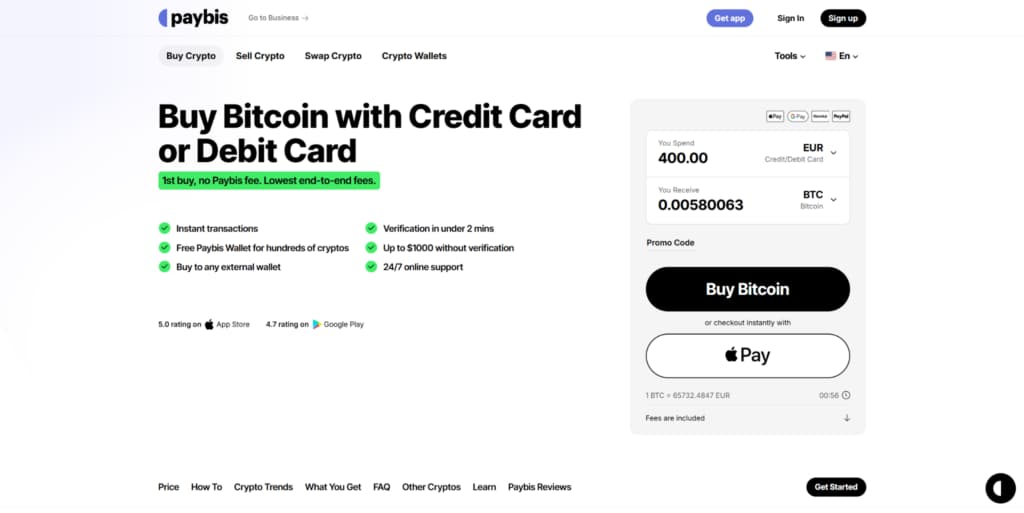
Paybis operates as a full-stack infrastructure layer for crypto and fiat payment flows, supporting businesses working with crypto payments, stablecoin settlement, and fiat conversion. The platform covers onboarding, payouts, payment processing, and wallet infrastructure within one system. This reduces the need to integrate and manage multiple vendors. Global reach spans 180+ countries and 48 US states. Centralized control over financial operations simplifies management.
Consolidation improves visibility and reduces operational overhead. Keeping flows within one system makes reconciliation easier. The platform scales across regions and payment methods without adding integration complexity.
Full Flow Control and System Consolidation
Most businesses rely on multiple providers to cover different functions. That creates fragmented data and integration failures. A unified system reduces these risks significantly. Centralized infrastructure improves monitoring and execution speed.
The platform brings together the following operational layers:
- Fiat-to-crypto and crypto-to-fiat on-off-ramp infrastructure;
- Global crypto and fiat payouts via API and dashboard;
- Support for payment processing and crypto acquiring;
- White-label wallets and embedded financial flows;
- Coverage across multiple regions, currencies, and payment methods.
Paybis works best for businesses that want full control over payment flows within a single system.
2. Zero Hash
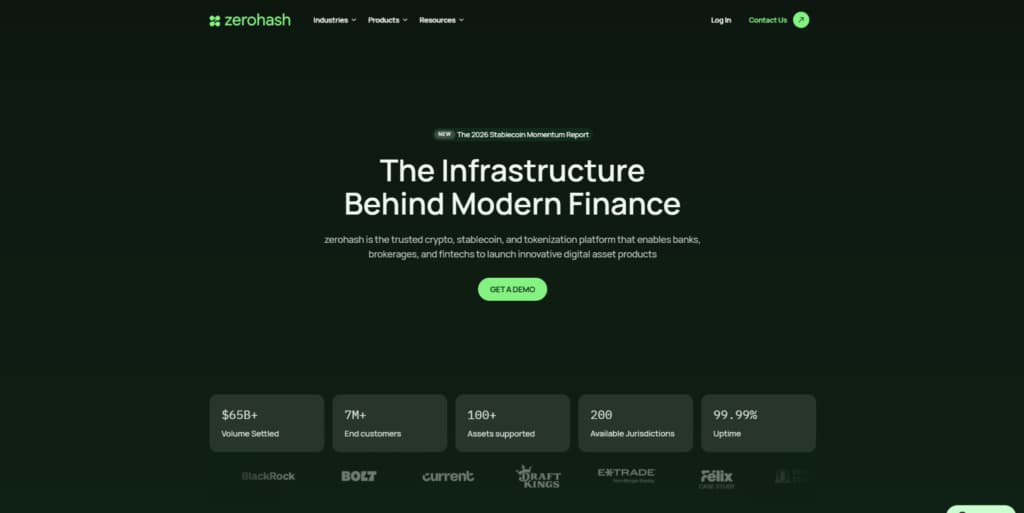
Zero Hash provides backend infrastructure for fintech platforms and financial institutions. The company handles payments, custody, and settlement behind the scenes. This is not a user-facing product. It is designed for regulated environments and large-scale operations.
Companies use Zero Hash to add crypto functionality without building internal systems. Reliability is consistent, and compliance is built into the system. The platform supports complex financial workflows at an institutional scale. Settlement runs consistently, custody meets institutional requirements, and the API gives teams control without exposing them to blockchain complexity.
Backend Systems for Financial Integration
Institutional environments need stable backend layers. Custody, settlement, and compliance cannot fail. Infrastructure must support high-value transactions consistently without interruption.
Its infrastructure is structured around the following elements:
- Crypto payments and settlement infrastructure;
- Custody and asset management systems;
- Regulatory and compliance integration;
- API-based infrastructure for fintech platforms;
- Support for institutional transaction flows.
Zero Hash fits products that require a regulated and scalable backend infrastructure.
3. Alchemy Pay
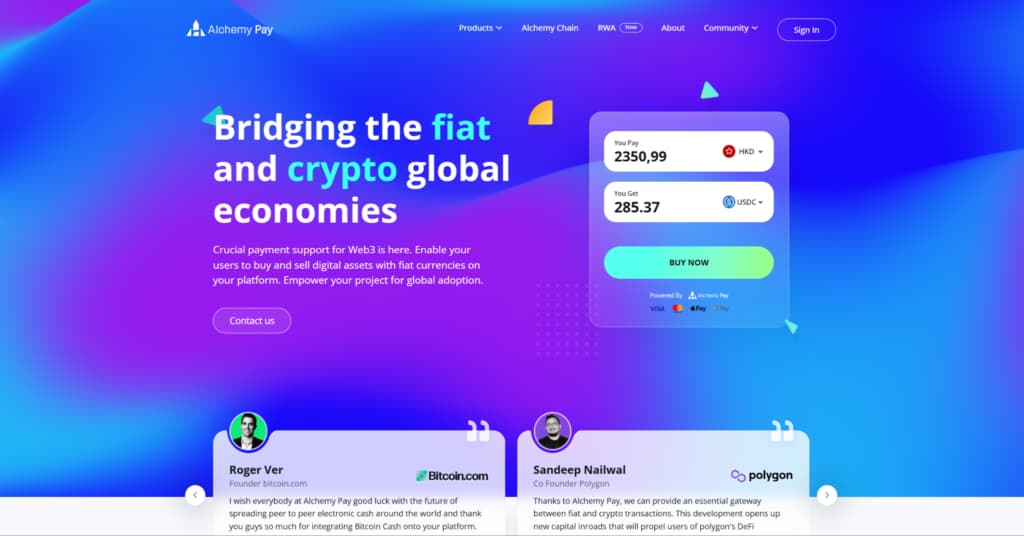
Alchemy Pay connects traditional payment systems with crypto through a global gateway. The platform supports a wide range of payment methods. It bridges fiat and crypto transactions across borders. This expands access across regions where crypto adoption is growing.
Local payment methods increase conversion and accessibility. Alchemy Pay supports multiple currencies and regions. The platform helps businesses scale beyond crypto-native users into mainstream markets. Hundreds of payment methods work through a single integration. Cross-border processing becomes faster. Regional payment preferences get handled automatically.
Cross-Border Access and Payment Coverage
Global payment flows require more than card processing. Regional payment preferences matter. Broader coverage directly increases adoption rates. Ignoring local methods often leads to lower conversion and missed markets.
This gateway is built around several key payment capabilities:
- Fiat-to-crypto gateway infrastructure;
- Support for hundreds of payment methods;
- Integration with local payment systems;
- Cross-border payment processing;
- Multi-region transaction support.
Alchemy Pay suits businesses expanding across multiple markets.
4. Transak
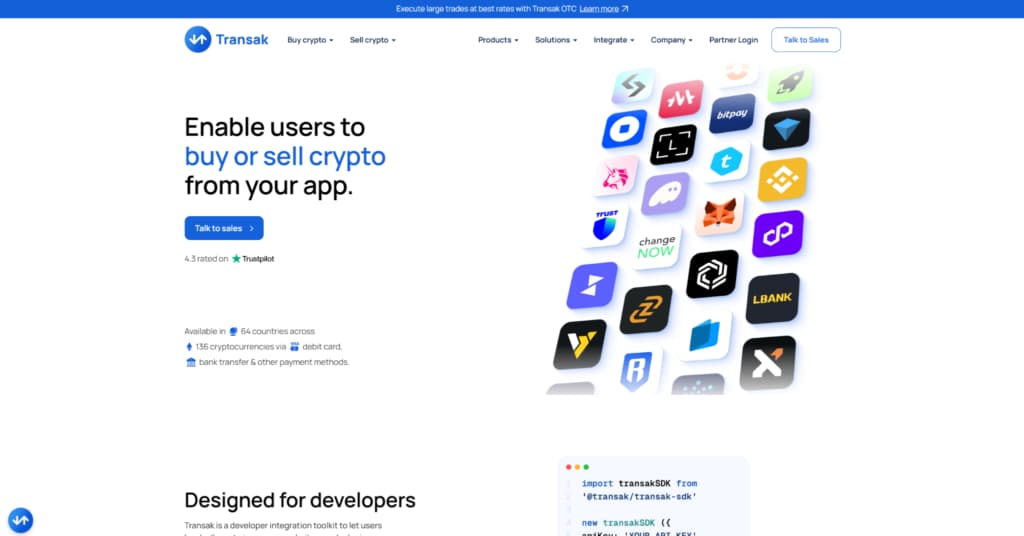
Transak provides on-ramp and off-ramp infrastructure with strong geographic coverage. The platform focuses on local payment methods across different regions. It enables access where other providers have limited presence. Emerging markets are a real strength here.
Localization reduces friction and improves onboarding success. Transak handles compliance across jurisdictions, so you don’t have to. Integration with Web3 platforms is straightforward. The platform manages regional payment quirks, settlement differences, and local regulatory requirements. You get one API that works across dozens of countries without rebuilding for each market.
Regional Payment Adaptation and Reach
Entering new markets requires adapting to local payment systems. Global-only methods have limitations. Regional flexibility improves performance and conversion. Ignoring local payment behavior often slows down user adoption and reduces success rates.
The platform focuses on the following operational areas:
- Global on-ramp and off-ramp infrastructure;
- Support for regional payment methods;
- Coverage in emerging markets;
- Compliance handling across jurisdictions;
- Integration with Web3 platforms and wallets.
Transak fits businesses targeting multi-region growth.
5. Ramp Network

Ramp focuses on onboarding users into crypto through fiat entry points. The platform offers developer-friendly APIs and quick integration. Web3 applications use it heavily. It serves as an entry layer for payment flows. The SDKs actually work. Documentation is solid.
Onboarding quality affects conversion and user growth. Smooth UX matters. Stable performance under load keeps users from dropping off. Ramp prioritizes acquisition over other functions. Integration takes days, not weeks. Transaction success rates stay high. Teams that need to launch fast and iterate often pick Ramp for the developer experience alone.
User Entry and Integration Efficiency
Reducing friction during onboarding increases adoption. Simple integration saves engineering time. Developer experience impacts how fast you can deploy. Slow or complex setups often delay product launches and limit early growth.
Ramp is designed around these functional advantages:
- Fiat-to-crypto onboarding infrastructure;
- Developer-friendly APIs and SDKs;
- Fast integration process;
- Stable transaction processing;
- Integration with wallets and Web3 applications.
Ramp works best for onboarding-focused products.
6. MoonPay

MoonPay provides payment infrastructure for crypto onboarding and offboarding at scale. The platform has a global reach and integrates with major players. It enables crypto payments across large user bases. Trustpilot ratings reflect real usage. The brand carries weight.
The platform supports multiple payment methods. Access to crypto becomes simpler. Reliability and scalability are proven at volume. MoonPay processes millions of transactions monthly. Uptime is consistent. When your user base grows from thousands to millions, the infrastructure doesn’t crack. That’s the value proposition here.
Scalable Payment Layer for Global Use
Large-scale systems need a stable payment infrastructure. Global reach must come with consistent performance. The platform must support growing transaction volume without breaking.
MoonPay structures its system around the following functions:
- Fiat-to-crypto and crypto-to-fiat processing;
- Global payment method support;
- Integration with large platforms;
- Scalable transaction handling;
- Tools for onboarding users.
MoonPay suits products operating at a significant scale.
How to Choose the Right Infrastructure Provider
Choosing the right provider depends on your business model and transaction flows. Map real use cases before selecting tools. Incorrect infrastructure leads to operational issues and scaling problems down the road.
Several factors influence performance and long-term stability. Evaluate infrastructure beyond feature lists. What works in a demo may fail under real volume.
When selecting a provider, focus on the following factors:
- Business model and use case requirements;
- Geographic coverage and payment methods needed;
- Integration complexity and available technical resources;
- Compliance and regulatory requirements in your markets;
- Scalability and transaction volume expectations.
A well-matched provider reduces operational friction and risk. The wrong choice creates hidden costs.
Final Thoughts
Crypto and fiat payments come from multiple infrastructure layers, not a single system. Each provider covers a specific part of the flow: onboarding, settlement, custody, or processing. In practice, businesses combine several tools to make these systems work together. The key factor is how well these components fit your real transaction flows, not how they look in isolation. A setup that works in theory can fail under real volume if the layers don’t align properly. Reliable systems come from testing how these parts perform together in real conditions, not from marketing materials.